

Pilots Don’t See Pixels: Why Simulation Is Finally Moving from Projection to LED
-
Author Owner and Founder
-
Published August 04
2026
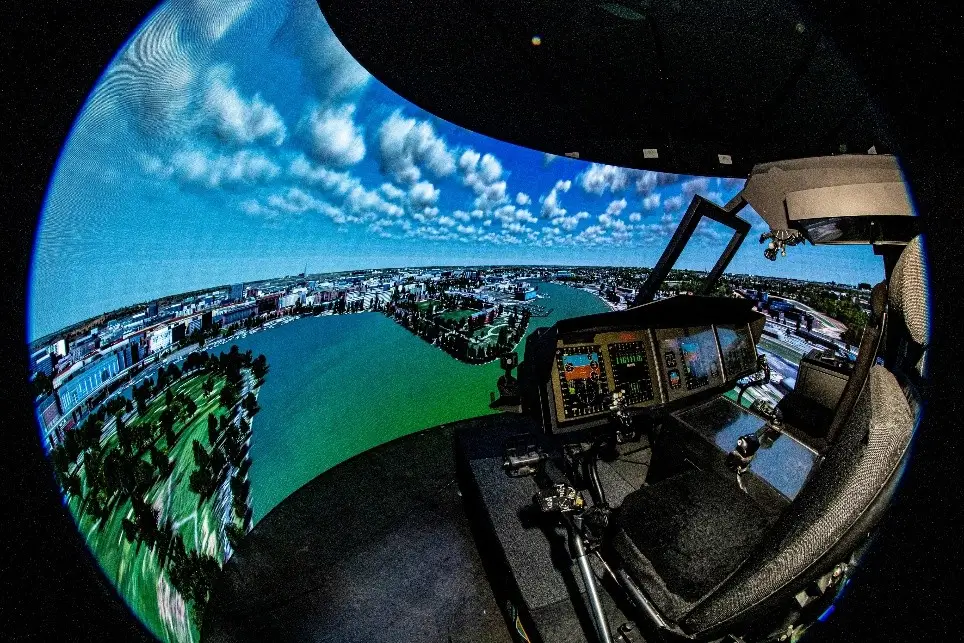
For most of my fourteen years in this business, if you asked me whether an LED display could replace a projection dome in a flight simulator, I’d have given you an honest answer: not yet. The resolution simply wasn’t there for the most demanding training environments. Projection, with all its headaches, was still the only way to hit the visual fidelity required from serious simulators.
That answer has now changed. I want to explain why, because I think it matters to anyone building or maintaining a simulation environment right now.
The metric that actually matters
Here’s something I’ve learned from working alongside the simulation community, including the government and military customers who make up about ten percent of our two-thousand-plus installations: pilots don’t perceive pixels. They perceive contrast boundaries — the edge of a runway marking, the texture of terrain, the shape of a distant target. That’s why the standards that govern this world, from the FAA and EASA to Full-Flight Simulator Level-D certification, don’t score raw pixel counts. They score visual MTF (Modulation Transfer Function) and optical line-pair resolution, measured in arc minutes, because that’s how the human eye actually works.
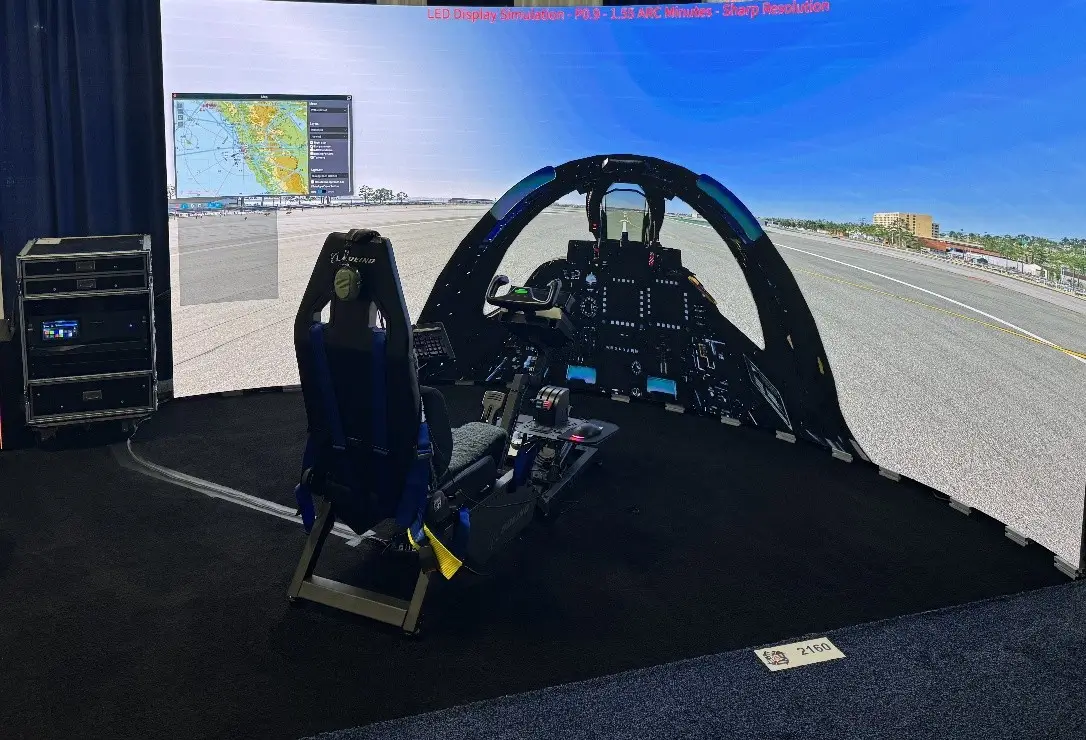
For years, that was projection’s unique advantage. LED couldn’t get the pixel pitch tight enough to compete on arc minutes. Today, flexible LED tiles are available at a 0.9mm pitch, delivering resolution around 1.24 arc minutes — competing directly with projection on the one metric that defines certification readiness. Depending on the degrees of curvature required for the cylinder or dome, the radius and configuration, designers can now approach sub-arc-minute performance where mission accuracy demands it using LED. That’s the breakthrough. Everything else LED does better was already true.
What “everything else” looks like
If you’ve ever maintained a multi-projector dome, you know the ritual. Multiple projectors, edge-blending software, and a physical alignment so delicate that if one projector gets bumped, every projector has to be recalibrated — a tedious, time-consuming job that requires skilled technicians. Add bulbs with short lifespans (laser projectors have helped, but haven’t eliminated the cost gap), and factor in that any ambient light from a window or doorway washes out your image, fading colors and flattening blacks.
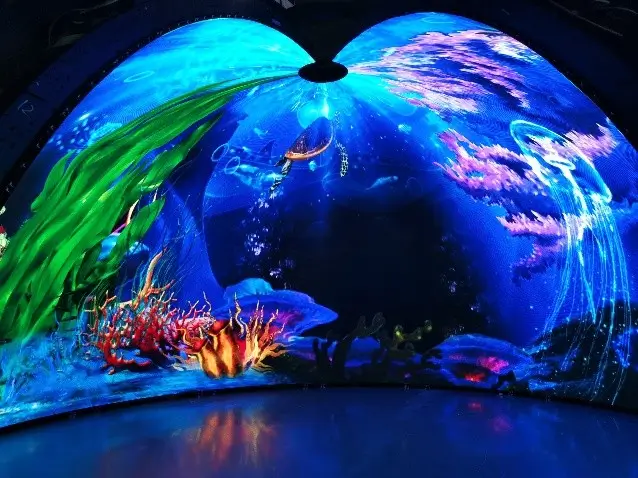
LED simply doesn’t carry that baggage. The image is fed directly to the surface, so ambient light is irrelevant and there’s nothing to knock out of alignment. There’s no edge blending, because there are no edges — flexible tiles let us build domes and cylinders with seamless, continuous curves. And scale stops being a constraint: need a bigger canvas, add more cabinets. Maintenance drops to little or nothing.
For a trainee, what all of this adds up to is clarity. Projection’s optical blending can soften exactly the fine details training depends on — signage, runway cues, terrain texture. An LED surface presents discrete structure with consistent contrast across the entire field of view, which supports the depth perception, parallax reading, and early runway recognition that pilot performance is built on. Whether it’s a commercial FTD (Flight Training Device), military mission rehearsal, or a JTAC (Joint Terminal Attack Controller) environment, those cues are the whole point.
How we approach it at Vanguard
I’ll be candid about how we work, because I think it explains why we can deliver in this space.
Vanguard is a small, agile team, and that’s deliberate. Over fourteen years, we’ve built intentional partnerships with a diverse group of factories that answer to our specifications and our customers’ needs — not the other way around. When a simulation project requires a specific pitch, a specific curve radius, or a specific latency target, we’re not shopping a catalog. We’re engineering a solution.
Simulation displays are unforgiving in a way that a lobby video wall is not. Pixel pitch, viewing radius, MTF (Modulation Transfer Function), fill factor, black level, latency — these factors interconnect, and together they determine whether a pilot can read a gauge or recognize a target during dynamic motion. Getting that right takes a partner who understands the interplay, not just a vendor who ships boxes.
That’s also why our customers come back. We have roughly 250 of them, and the relationship never ends at installation. The simulation world evolves, requirements tighten, and technology like 0.9mm flexible panels opens doors that were closed a year ago. Our job is to stay ahead of that curve on our customers’ behalf.
The bottom line
Projection served simulation well for a long time. But LED now matches it where it counts — measurable, certifiable visual resolution — and conveniently beats it everywhere else as well: stability, maintenance, ambient light immunity, scalability, and seamless imagery across domes and cylinders. By aligning with how pilots actually see the world, LED lets simulation systems deliver visuals with mission-ready fidelity and predictable performance for years.
If you’re planning a simulation environment, or you’re tired of realigning projectors, I’d genuinely enjoy the conversation. After over two thousand installations, it’s still my favorite part of the job.
Recent Post
Featured Post
Mastering the Art of Outdoor LED Displays: A Comprehensive Guide
REACH OUT TO US
Fill out the form below, and lets get started!
Please Note: To ensure legitimate corporate inquiries, only business email addresses are accepted. Submissions from consumer email providers (e.g., Gmail, Yahoo, Hotmail, Ymail) will not move forward.