
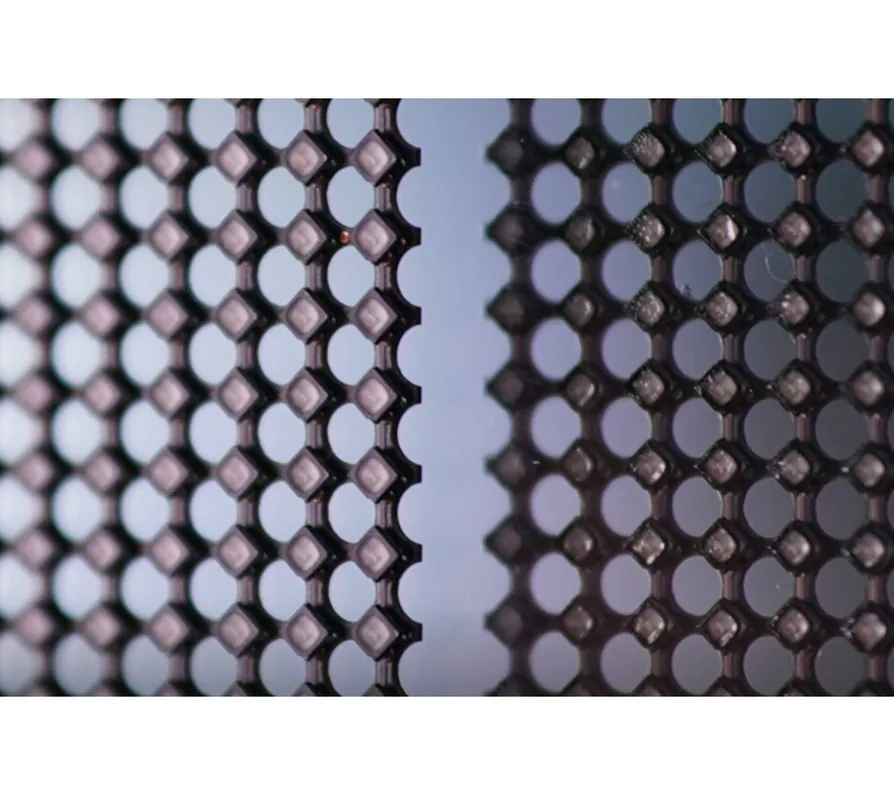
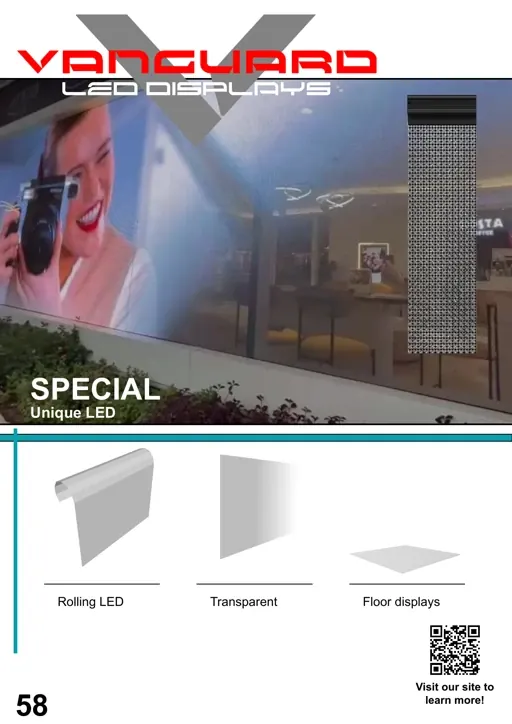
Special · Transparent hanging or window-mounted displays
Houdini
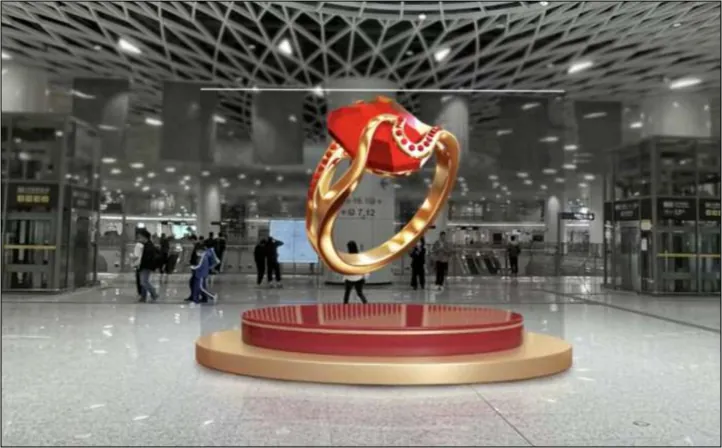
Transparent LED Display Film for Glass and Open Air
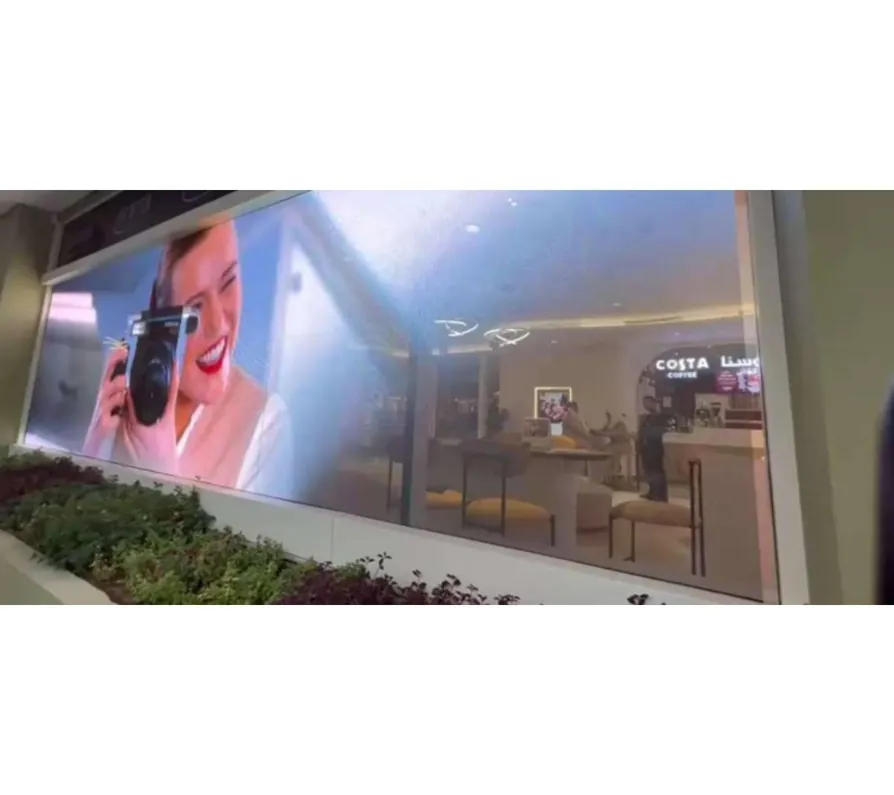
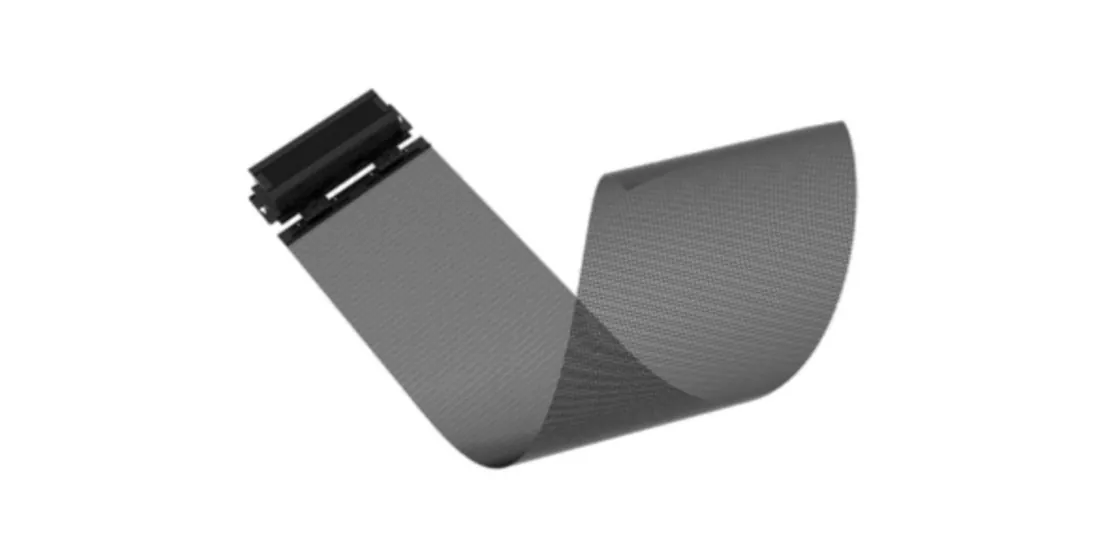
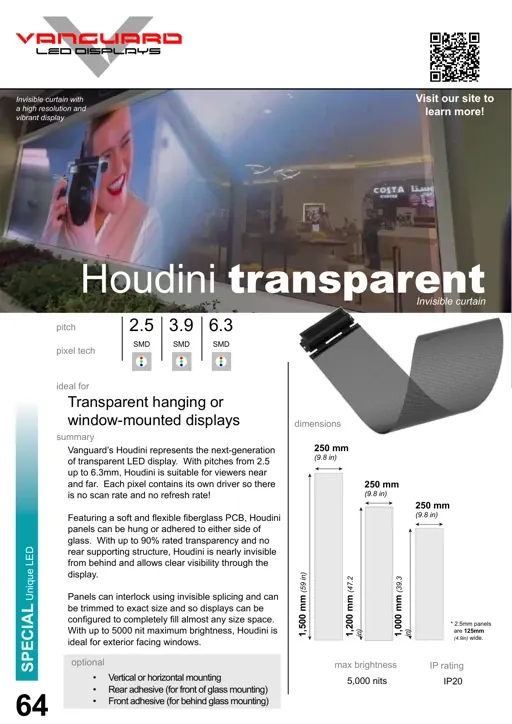
The Houdini is a transparent LED display only 1.8 mm thick that hangs in open air or adheres to either side of glass, turning storefronts, atrium windows, and curtain walls into video surfaces that remain up to 90 percent see-through. Each pixel carries its own driver, so there is no scan rate and no visible refresh on camera. The flexible fiberglass PCB needs no rear structure, can be cut to size, and splices together with near-invisible connectors.
Ideal for Transparent hanging or window-mounted displays
Pixel pitch (mm)
- 2.5SMD
- 3.9SMD
- 6.3SMD
Specifications
Houdini
Panel configuration
| Transparency | 70% |
|---|---|
| Maximum brightness | 1,200 nits |
| Module width | 125 mm |
| Module height | 1,500 mm |
General specifications
| LED half-life | 100,000 hours |
|---|---|
| Refresh rate | 3,840 Hz |
| Frame rate | 50, 60, 120 Hz |
| Color temperature | 6,500 K default (3,000-9,000 K range) |
| Processing depth | Up to 16 bits |
| Scan rate | No scan rate; static integrated IC drivers |
| Temperatures | −20°C to +50°C |
| Operating humidity | 20-85% RH, non-condensing |
| Operating voltage | 100-240 V AC, 50/60 Hz |
| Maximum watts | 1,000 W/m² |
| IP rating | IP20 |
| Maximum heat | 3,410 BTU/hr/m² |
| Service access | Front |
| Warranty | 3-year default (up to 5-year available) |
| Certifications | EMC, ISO, CCC, ICC, CB, FCC, CE, ETL, RoHS |
Panel configuration
| Transparency | 80% |
|---|---|
| Maximum brightness | 3,000 nits |
| Module width | 250 mm |
| Module height | 1,500 mm |
General specifications
| LED half-life | 100,000 hours |
|---|---|
| Refresh rate | 3,840 Hz |
| Frame rate | 50, 60, 120 Hz |
| Color temperature | 6,500 K default (3,000-9,000 K range) |
| Processing depth | Up to 16 bits |
| Scan rate | No scan rate; static integrated IC drivers |
| Temperatures | −20°C to +50°C |
| Operating humidity | 20-85% RH, non-condensing |
| Operating voltage | 100-240 V AC, 50/60 Hz |
| Maximum watts | 1,000 W/m² |
| IP rating | IP20 |
| Maximum heat | 3,410 BTU/hr/m² |
| Service access | Front |
| Warranty | 3-year default (up to 5-year available) |
| Certifications | EMC, ISO, CCC, ICC, CB, FCC, CE, ETL, RoHS |
Panel configuration
| Transparency | 90% |
|---|---|
| Maximum brightness | 5,000 nits |
| Module width | 250 mm |
| Module height | 1,500 mm |
General specifications
| LED half-life | 100,000 hours |
|---|---|
| Refresh rate | 3,840 Hz |
| Frame rate | 50, 60, 120 Hz |
| Color temperature | 6,500 K default (3,000-9,000 K range) |
| Processing depth | Up to 16 bits |
| Scan rate | No scan rate; static integrated IC drivers |
| Temperatures | −20°C to +50°C |
| Operating humidity | 20-85% RH, non-condensing |
| Operating voltage | 100-240 V AC, 50/60 Hz |
| Maximum watts | 1,000 W/m² |
| IP rating | IP20 |
| Maximum heat | 3,410 BTU/hr/m² |
| Service access | Front |
| Warranty | 3-year default (up to 5-year available) |
| Certifications | EMC, ISO, CCC, ICC, CB, FCC, CE, ETL, RoHS |
Panel sizes
Sizes and configuration
- modules 125 mm (2.5 mm pitch) or 250 mm (3.9 and 6.3 mm) wide, by 1,000, 1,200 or
Applications
Where it is used
- Retail storefront windows that advertise without blocking the view inside
- Glass atriums, lobbies, and curtain-wall buildings
- Car dealerships, museums, and showrooms
- Trade-show and event "invisible curtain" installations hung from truss
Add-ons & accessories
Configure it your way
 EM: epoxy mask (HOB)
 EC: epoxy coating (GOB)
 Trim: cosmetic edge protection
 45° edges: convex and outside corners
 Secure connection plates
 Flight cases

Projects
Houdini in place


Frequently asked questions
About Houdini
What is the Houdini Transparent series?
Houdini is our transparent LED display series — a soft, flexible fiberglass-based display that people see through, showing vibrant content while preserving the view behind it. With up to 90% rated transparency, no rear structure, and panels that hang freely or adhere to glass, Houdini turns windows, facades, and open air into display surfaces.
What makes Houdini stand out from regular LED displays?
Houdini is nearly invisible when idle or viewed from behind: up to 90% transparency, no rear supporting structure, and a soft, flexible fiberglass PCB instead of a rigid panel. Content appears to float on the glass — or in open air — while visibility through the display remains clear from both sides.
What pixel pitches does Houdini come in?
Houdini comes in four pitches — 2.5mm, 3.9mm, 6.3mm, and 10mm — and pitch selection works differently here: transparency and brightness increase with pitch. The 2.5mm delivers 70% transparency at 1,200 nits for close viewing; 3.9mm reaches 80% and 3,000 nits; 6.3mm achieves 90% transparency at 5,000 nits; and the 10mm extends the series to its longest viewing distances and most open configurations.
How transparent is a Houdini display?
Transparency scales with pixel pitch: 70% at 2.5mm, 80% at 3.9mm, and 90% at 6.3mm — the wider the pixel spacing, the more open area light passes through. Choosing a Houdini configuration means balancing viewing distance against how invisible the display should be, with even the finest pitch keeping most of the view intact.
Is Houdini bright enough for sunny windows?
Yes — Houdini reaches up to 5,000 nits maximum brightness, keeping content sharp and legible even in exterior-facing windows under direct sunlight. Brightness scales with pitch, with the high-transparency configurations delivering the most output — precisely the models suited to storefront glass.
Can Houdini be hung freely or mounted on any glass?
Both — Houdini's flexible panels adhere to either side of glass on nearly any storefront, facade, or atrium surface, and can also hang independently as a free-floating curtain with air passing through the display itself.
Should Houdini's LEDs shine through the glass or away from it?
In short LEDs can shine through the glass (display protected indoors) or face away from it (wider viewing angles, but weather-exposed on exterior windows).
Either work, it depends on the application. Mounted with LEDs shining through the glass, the display adheres inside the building — ideal for retail, with content facing the street while hardware stays indoors and protected. Mounted with LEDs facing away from the glass, viewers get wider clear angles since they aren't looking through the glass depth — but on exterior windows this places the display outside the building's protection, exposing it to the elements. Adhesion is non-permanent either way, so modules remove, service, and reinstall cleanly.
Can Houdini be adjusted to unique spaces?
Yes — Houdini panels can be trimmed to exact length and interlock through a splicing connection that preserves transparency, with splices nearly invisible except from behind at certain angles. Custom windows, unusual shapes, and massive glass walls fill completely, with transparency and image quality intact.
How does Houdini's pixel drive differ from conventional LED?
Every Houdini pixel contains its own static integrated driver — pixels are always lit rather than scanned row-by-row, eliminating scan rate entirely — while refreshing at 3,840Hz. The result is an exceptionally stable image with up to 16-bit processing depth and adjustable color temperature from 3,000K to 9,000K.
Is Houdini suitable for on-camera use?
Yes — because Houdini's pixels are statically driven, there are no scan lines by architecture, and 3,840Hz refresh keeps the image clean on video. Transparent displays photograph memorably — content appearing to float in air or on glass — making Houdini a distinctive choice for filmed events, broadcast backdrops, and social-ready installations.
Can individual Houdini pixels be repaired?
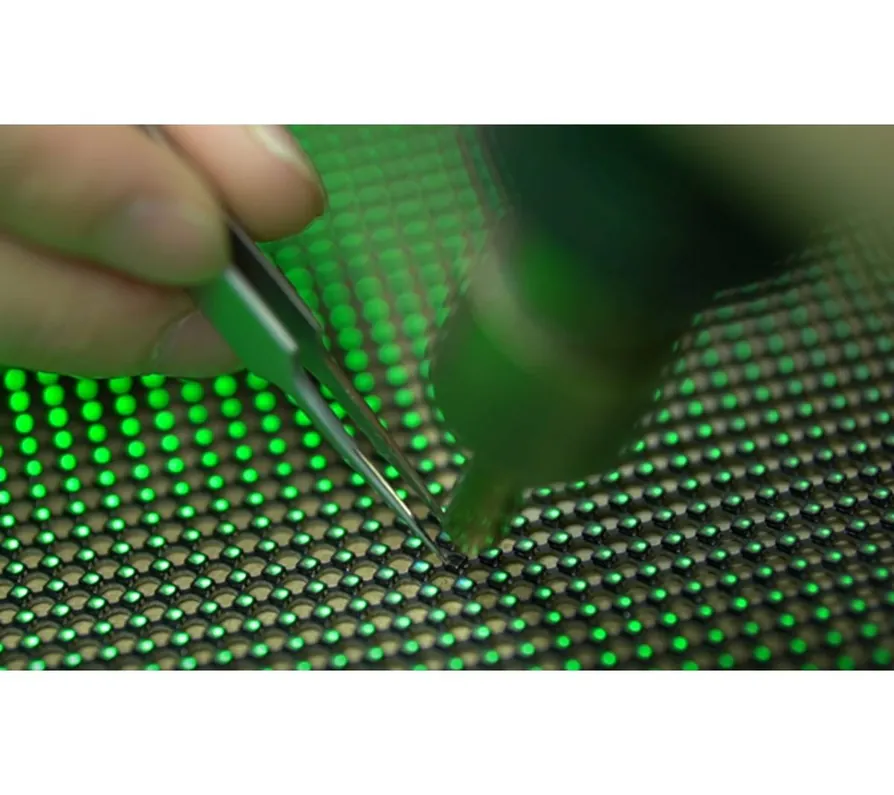
In short Yes — unlike most transparent LED, where pixel damage means discarding the module, Houdini pixels repair like standard SMD, and can even be replaced in place.
Most transparent LED encases pixels in a clear substrate — pixel damage means discarding an unserviceable module. Houdini repairs like any SMD display: remove the module, replace the pixel, return it to spare stock. When hung freely or with glass behind the modules, pixels can even be replaced in place, no removal required. A transparent display that's actually repairable protects the investment for its full lifespan.
What warranty and service come with Houdini?
Houdini includes a 3-year warranty, with coverage up to 5 years available and sufficient spare parts included. Service is front-access and module-level: because glass adhesion is non-permanent, individual modules remove, repair, and reinstall without disturbing the surrounding display — maintenance as unobtrusive as the display itself.
How transparent is it?
Between 70 and 90 percent depending on pitch; the 6.3 mm model is the most transparent, the 2.5 mm model the sharpest.
Does it need a frame or backing?
No. Houdini mounts directly to glass with adhesive or hangs free with no rear support structure, and air passes through a hanging installation.
Which side of the glass does it go on?
Either. Behind the glass, LEDs shine through the pane and the film is protected and serviceable from inside. In front of the glass, viewing angles are wider.
Will it flicker on camera?
No. Each pixel has its own driver, so there is no scan rate and no refresh artifact in photos or video.
Can it be repaired?
Yes, using the same technique as a standard SMD LED display.