

Reliability is a Mission Requirement: Lessons from the Front Lines of Military LED Integration

-
Author President - Vanguard LED Displays
-
Published March 12
2026
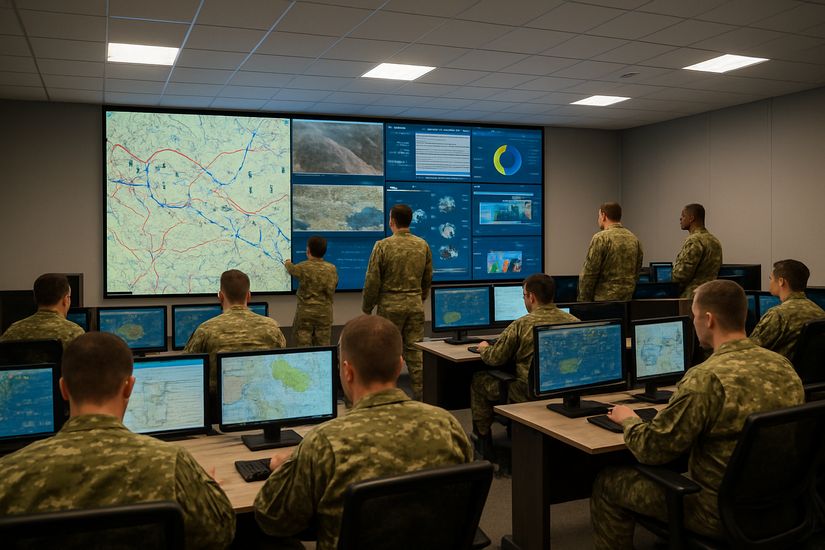
I recently walked into a command center and saw a nightmare: competitor screens hanging off poles from the floor and ceiling, held together by a “spaghetti” of copper cabling. Different color jackets, some marked, some not, running in every direction. It was chaos. My first thought wasn’t about the display quality—it was: “Holy crap, the poor soul who has to rip this out and re-run it is in for a disaster.”
I don’t look at a screen as a piece of “tech.” I see it as a link in a chain. In a mission-critical environment, if that link breaks, the chain fails.
The LPTA Trap: When “Cheap” Costs Lives
Most companies will sell whatever the customer asks for without pausing to consider what that system actually needs to do. In a Tactical Operations Center or a SCIF, my job is to be the reality check. We aren’t just hanging TVs; we are establishing situational awareness.
Everything in that room needs to fit together like perfectly placed building blocks. If one block is off—a failed module, a dead power supply, a flaky receiving card, a bad termination—it isn’t just a technical glitch. In our field, one bad block could cost American lives. We don’t deliver hardware; we deliver a functional system which reliably work with every other component in order to protect the mission.
Engineering for the “Wire”
Getting a team into a secure environment is a logistical gauntlet. Since manufacturers don’t carry active security clearances, we live the reality of the “escort life.” We shut down the space, get checked for Bluetooth, Wi-Fi, recording devices, and storage media. Every background and nationality is vetted.
Getting a laptop into a SCIF-rated space is usually flat-out impossible. I recognized that the industry was failing here, and it became a priority to solve that problem. When developing our Sentinel and Infinity ULTRA Processor series, we embedded the control and configuration software directly into an interface that runs on the processors themselves, enabling every aspect of programming without any separate device or software. In a secure space, the last thing you need is a “security theater” nightmare just to get your wall up and running. Hosting the software on the device also eliminates any compatibility concerns between software versions and the display.
True Redundancy: Failure is Not an Option
“Mission Critical” isn’t a marketing buzzword; it’s a design philosophy. That is why we integrate dual redundant power and data processing into every single cabinet.
At no point should a display go dark, especially in a space where situational awareness is the difference between success and failure. Our displays won’t go down in the middle of a mission. Period. We aren’t building for the “best case” scenario; we are building for the moment when everything else is going wrong and the commander needs to see the board.
The 72-Hour “Torture Test”
I don’t believe in hand-offs. I believe in stress tests.
Before any system leaves our facility, it runs through a rigorous 72-hour aging process designed to force failures in weak components while they’re still on our floor—not yours. If something is going to fail, I want it to fail in front of me. Then, during the handover itself, I then run a second complete stress test: every display, every controller, every input and output, tested again to confirm it is fully mission-ready.
And I don’t leave until the on-site Point of Contact knows the system as well as I do. That means walking through troubleshooting, handing over spare parts, and making sure there’s a human being on-site who can respond—not just a support ticket. That’s not a service policy. That’s just how I was raised to do this job.
My Personal Guarantee
I believe so much in what we build at Vanguard LED Displays that I stand wholly behind our industry-leading 10-year warranty. No other manufacturer can offer anything close to that—because most aren’t building to the same standard.
We don’t build these displays to survive the first year. We build them to serve the warfighter for a decade. When the mission goes live, the technology should be the last thing on your mind.
Recent Post
Featured Post
Mastering the Art of Outdoor LED Displays: A Comprehensive Guide
REACH OUT TO US
Fill out the form below, and lets get started!
Please Note: To ensure legitimate corporate inquiries, only business email addresses are accepted. Submissions from consumer email providers (e.g., Gmail, Yahoo, Hotmail, Ymail) will not move forward.
Demo Title
This will close in 50 seconds